
Table of Contents
ToggleHarbor Freight’s Hercules line has carved out a niche among DIYers who need pro-level features without the pro-level price tag. The Hercules miter saw sits at the center of that value proposition, a 12-inch sliding compound saw that punches well above its weight class. For anyone framing a wall, installing crown molding, or tackling weekend woodworking projects, this tool deserves a closer look. It’s not trying to replace a $600 DeWalt in a cabinet shop, but for homeowners who need clean, repeatable cuts without draining the project budget, it’s become a surprisingly capable workhorse.
Key Takeaways
- The Hercules miter saw delivers professional-grade features—dual-bevel capability, 15-amp motor, and linear ball bearings—at roughly half the price of premium contractor models, making it ideal for homeowners and DIYers on a budget.
- This 12-inch sliding compound miter saw excels at trim and molding work, with a dual-bevel range of 0° to 48° that eliminates the need to flip materials, saving significant time on multi-room crown and baseboard installation projects.
- While the Hercules miter saw achieves 85% of premium-saw performance for 60% of the cost, it’s best suited for homeowners, weekend woodworkers, and backup contractor tools rather than cabinet makers requiring 1/64-inch tolerances.
- Proper calibration at setup—verifying miter and bevel accuracy with a digital angle gauge—is essential to maximize the saw’s accuracy potential and prevent costly errors on finish work.
- The saw handles pressure-treated lumber, hardwoods, and thick molding profiles without motor bog-down, but requires regular rail cleaning and blade maintenance to sustain smooth operation and cut quality over time.
What Is the Hercules Miter Saw?
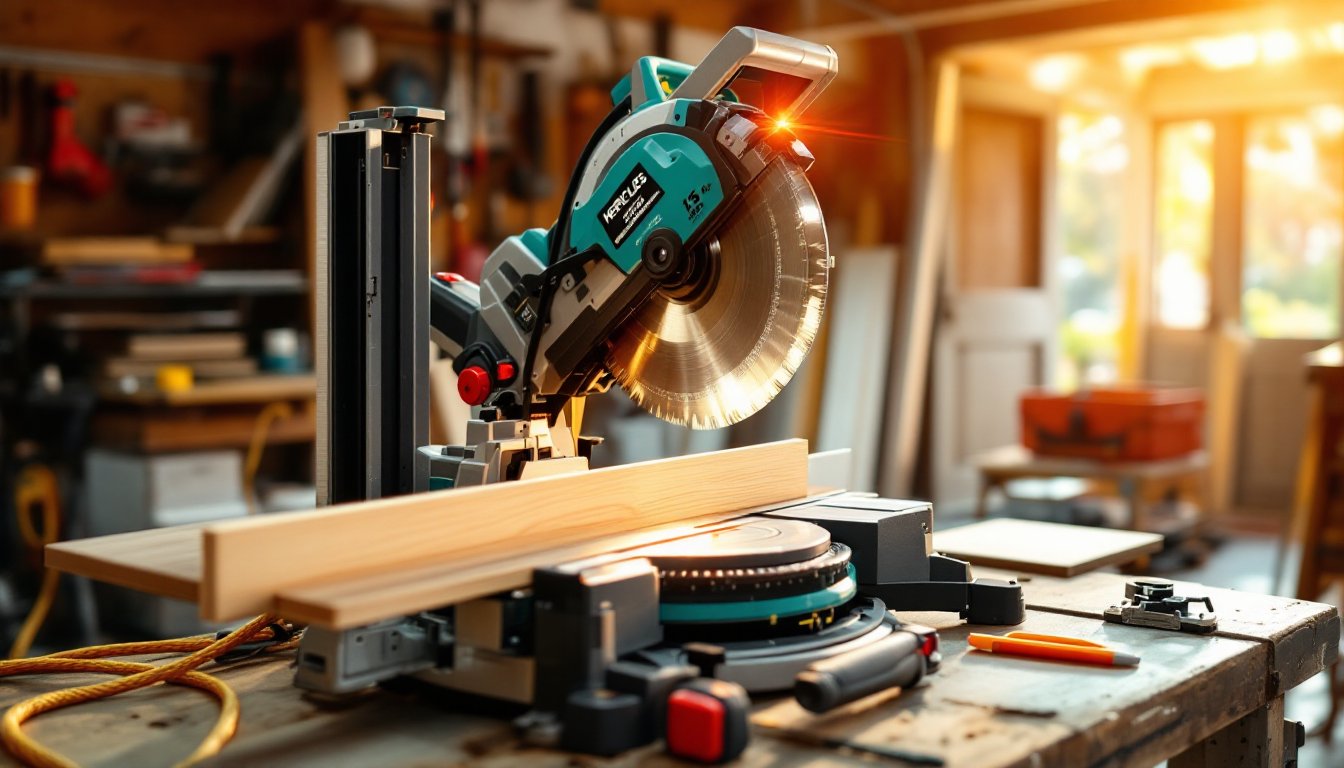
The Hercules 12-inch sliding compound miter saw is a Harbor Freight house-brand power tool designed to compete with mid-tier contractor saws at roughly half the cost. It features a 15-amp motor, dual sliding rails, and bevel capabilities in both directions, features you’d typically find on saws priced $400 and up.
Unlike Harbor Freight’s older Pittsburgh and Chicago Electric lines, Hercules tools aim for the serious DIYer and weekend contractor. The miter saw model (SKU 63955) became one of the brand’s flagship offerings when it launched, with a build quality that surprised many longtime tool skeptics.
The saw handles 12-inch blades and ships with a 60-tooth carbide-tipped blade suitable for crosscutting dimensional lumber and trim. Out of the box, it’s set up for common miter angles (0°, 15°, 22.5°, 31.6°, 45°) with positive stops and a dual-bevel range of 0° to 48° left and right. That means you can cut crown molding flat on the table without flipping the workpiece, a genuine time-saver for trim work.
Key Features and Specifications
Here’s what sets the Hercules apart in its price bracket:
Motor and Power
- 15-amp, 4,000 RPM motor delivers enough torque for hardwoods and engineered lumber
- Soft-start function reduces startup jolt and extends motor life
- Electric brake stops the blade in under 3 seconds for safer workflow
Cutting Capacity
- Crosscut capacity: 13 inches at 90°, 9-1/2 inches at 45°
- Vertical capacity: 6-1/2 inches nested crown, 5-1/2 inches base at 90°
- Slides smoothly on dual horizontal rails with minimal deflection
Accuracy Features
- Laser guide system (requires two AAA batteries) projects a visible cut line
- Miter detents at all common angles with a quick-release override lever
- Adjustable miter scale with 1/10-degree markings
- Tall, extendable fences support crown molding and wide boards
Build Quality
- Die-cast aluminum base and pivot components (not stamped steel)
- Stainless steel miter detent plate resists wear better than painted steel
- Dust port accepts standard 2-1/4-inch shop vac hoses
The saw weighs 54 pounds, making it portable but stable enough not to walk during aggressive cuts. The carry handle is well-balanced, though you’ll still want both hands when moving it between job sites.
Performance and Cutting Capabilities
In real-world use, the Hercules handles nominal 2×8 lumber (actual 1-1/2 × 7-1/4 inches) and 5-1/4-inch baseboard with no bog-down. The 15-amp motor maintains RPM through oak, maple, and pressure-treated yellow pine without the laboring you’d expect from a budget saw.
Bevel cuts stay accurate through the full 48-degree range, though like most saws in this class, you’ll want to verify your setup with a digital angle gauge before committing to finish cuts. The factory bevel calibration is typically within half a degree, close, but not tight enough for fine furniture work without adjustment.
The laser guide is a mixed bag. It’s genuinely useful in dim garages or when cutting dark materials, but the alignment drifts slightly as the saw heats up during extended sessions. Seasoned DIYers tend to rely on blade-to-pencil-mark alignment and use the laser as a secondary reference.
One standout feature: the sliding mechanism uses linear ball bearings rather than the cheaper post-and-collar design found on many budget saws. This means smoother operation and less side-to-side play, which translates directly to cleaner cuts on wide stock.
Who Should Consider a Hercules Miter Saw?
This saw makes the most sense for three groups:
Homeowners tackling multi-room trim projects
If you’re installing baseboards, door casings, and crown molding throughout a house, the Hercules will handle thousands of cuts without complaint. The dual-bevel feature alone saves hours compared to single-bevel saws that force you to flip molding and recalculate angles.
Weekend woodworkers on a budget
Building furniture, outdoor projects, or shop fixtures doesn’t always justify a $500+ saw. The Hercules delivers repeatable cuts for sturdy projects without the premium price. Just don’t expect the ultra-fine tolerances required for high-end cabinetry.
Contractors who need a backup or job-site beater
Pros with a high-end saw at the shop often appreciate a second saw for rough framing or sites where theft and weather are concerns. At roughly $300, the Hercules is cheap enough to replace but capable enough to trust with paying work.
Who should skip it?
Cabinet makers and finish carpenters working to 1/64-inch tolerances will find the saw’s repeatability frustrating. The fences aren’t as rigid as top-tier models, and micro-adjustments require more finesse. Also, anyone cutting materials that require non-ferrous blades (aluminum, vinyl) should verify blade compatibility, the arbor and RPM are standard, but the saw’s design prioritizes wood cutting.
How Does It Compare to Other Budget Miter Saws?
In the $250–$350 range, the Hercules competes directly with the Ryobi TSS102L, Delta S26-271L, and older Craftsman 21237 models. Here’s how it stacks up:
Hercules vs. Ryobi TSS102L
The Ryobi costs about $50 more and offers a sliding fence system that’s easier to adjust for crown molding. But, the Hercules motor has noticeably more torque in hardwoods, and the dual-bevel range is 3 degrees wider. The Ryobi’s warranty (3 years) beats Harbor Freight’s coverage, but the Hercules feels more solidly built.
Hercules vs. Delta S26-271L
Delta’s entry is nearly identical in specs but harder to find in stock. The Delta uses a slightly different laser system that some users find more reliable, but parts availability through Harbor Freight gives the Hercules an edge for long-term maintenance.
Hercules vs. Entry-Level DeWalt (DWS779)
The DeWalt costs $150–$200 more and justifies it with better dust collection, a more durable detent system, and tighter out-of-box calibration. For pros, that’s money well spent. For DIYers cutting a few hundred linear feet per year, the Hercules delivers 85% of the performance at 60% of the cost.
If you’re comparing tools for seasonal home maintenance tasks, the Hercules offers enough capacity and precision for deck repairs, fence building, and interior upgrades without over-investing in features you’ll rarely use.
Setup, Maintenance, and Best Practices
Initial Setup
- Unbox on a sturdy surface. The saw arrives partially assembled: you’ll attach the fences, blade guard, and dust bag.
- Check and calibrate the miter scale. Use a known-accurate square against the fence and blade, then adjust the 0° stop if needed. The adjustment screws are accessible beneath the table.
- Verify bevel accuracy at 0° and 45°. Most saws arrive within spec, but confirm before your first project. A digital angle gauge ($20–$30) pays for itself in avoided mistakes.
- Install fresh batteries in the laser. The factory batteries are often near-dead from shelf time.
Ongoing Maintenance
- Clean the sliding rails monthly if you’re cutting treated lumber or working in dusty conditions. A dry brush and occasional spray of dry PTFE lubricant keep movement smooth.
- Inspect the blade for pitch buildup. Sap and resin dull teeth faster than normal wear. Soak blades in pitch remover or use a brass brush before storage.
- Tighten the bevel lock handle if you notice drift during cuts. The lock mechanism can loosen with heavy use: a quarter-turn usually restores firm lockup.
- Check the dust port connection. The friction-fit port can vibrate loose. A wrap of electrical tape creates a tighter seal for shop vac hoses.
Safety Essentials
- Always wear safety glasses and hearing protection. Miter saws throw debris and operate at 95+ decibels.
- Use a dust mask or respirator when cutting pressure-treated lumber, MDF, or exotic hardwoods.
- Keep hands 6 inches from the blade path. Use clamps or hold-downs for small pieces, never rely on hand pressure alone.
- Unplug during blade changes. The electric brake is reliable, but zero risk beats low risk.
Blade Upgrades
The stock 60-tooth blade works fine for framing lumber and softwood trim, but upgrading to an 80-tooth blade ($30–$50) dramatically improves cut quality on hardwood and painted materials. For molding, a high-ATB (alternate top bevel) grind minimizes tear-out. Freud and Diablo make excellent 12-inch blades that fit standard 1-inch arbors.
Common DIY Projects Perfect for the Hercules Miter Saw
The Hercules shines on projects where accuracy matters but tolerances aren’t cabinet-grade:
Baseboard and Crown Molding Installation
The dual-bevel capability makes inside and outside corners straightforward. Cut crown molding flat on the table (spring angle doesn’t matter), and you’ll save hours compared to coping joints. For rooms with out-of-square corners, common in homes built before laser levels, the micro-adjustable miter scale lets you dial in perfect fits.
Deck Building and Outdoor Structures
Cutting pressure-treated 2×6 joists, railing components, and stair stringers is well within the saw’s capacity. The extended fences support 12-foot boards with outfeed assistance, and the motor handles wet treated lumber without bogging. Just clean the saw thoroughly afterward, treated lumber dust is corrosive.
Picture Frames and Small Woodworking
For frames up to 12 inches wide, the Hercules provides tight miters if you take time to calibrate and use a sharp blade. Add a zero-clearance insert (easy to make from 1/4-inch hardboard) to prevent tear-out on the underside of delicate stock.
Window and Door Casing
Cutting casing for home renovation projects requires consistent 45-degree miters and the ability to handle 5- to 7-inch-wide stock. The Hercules nested crown capacity translates to clean cuts on most casing profiles without needing to remove the fences.
Furniture Rough-Cutting
While a table saw is better for ripping sheet goods, the miter saw excels at breaking down lumber into project-length pieces. Cutting table legs to identical length, crosscutting boards for glue-ups, and trimming shelf components all go faster with the repeatable stop system.
Not Recommended For
- Production cabinet work requiring 1/32-inch repeatability across hundreds of cuts
- Metal cutting (use a dedicated cold-cut saw with appropriate blade and RPM)
- Tile or masonry (wrong blade speed and insufficient dust management)
The saw’s sweet spot is projects where accuracy matters, volume is moderate, and budget is a real constraint. It won’t replace a $1,200 Festool, but it’ll handle 95% of what a homeowner or hobbyist woodworker needs.