
Table of Contents
ToggleSmart thermostats have moved from luxury gadgets to practical tools for cutting energy bills and automating climate control. But choosing between Ecobee and Nest, the two dominant players, isn’t straightforward. Both offer scheduling, remote control, and energy tracking, yet they take different approaches to interface design, sensor technology, and smart home compatibility. Homeowners upgrading from a manual or programmable thermostat need to understand these differences before committing to a system that’ll control their HVAC for the next decade. This comparison breaks down what each does well, where they fall short, and which fits specific home setups and DIY skill levels.
Key Takeaways
- Ecobee vs. Nest thermostats both deliver 10–23% energy savings and remote control, but Ecobee excels in multi-room homes with included sensors while Nest offers superior design and tighter Google integration for smaller spaces.
- Ecobee supports Apple HomeKit, Alexa, and Google Assistant out of the box, while Nest integrates exclusively with Google Home and dropped HomeKit support, making Ecobee the better choice for multi-platform smart homes.
- Ecobee’s Premium model ($249) includes a built-in Alexa speaker and SmartSensor to avoid hot/cold spots across rooms, whereas Nest Learning (4th gen, $279) prioritizes aesthetics with a borderless circular display but requires separate temperature sensors ($40 each).
- Installation is DIY-friendly for both if you have existing wiring, but older homes lacking a C-wire will require a power adapter ($100–$200 professional installation), and utility rebates of $50–$100 can significantly reduce out-of-pocket costs.
- Ecobee’s multi-sensor approach and Nest’s machine learning algorithm both justify their investment within two years through HVAC savings, making the choice depend on your home layout, smart home ecosystem, and whether you prioritize screen size or premium design.
Key Features Compared: Ecobee and Nest at a Glance
Ecobee thermostats ship with a SmartSensor in most bundles, allowing room-specific temperature readings. The sensor detects occupancy and temperature in bedrooms, home offices, or other zones, then averages readings to avoid hot or cold spots. This matters in multi-story homes or rooms with poor airflow where a single thermostat reading misses the mark.
Nest relies on its built-in motion sensor and Nest Temperature Sensor (sold separately, around $40 each). The Google-owned platform emphasizes machine learning: it studies your schedule, adjusts temperatures automatically, and displays an energy-saving “Leaf” icon when settings are efficient. The Nest Learning Thermostat (4th gen, released late 2024) features a larger touchscreen and improved radar-based occupancy detection compared to earlier models.
Both support geofencing (using your phone’s location to switch to away mode), voice control via Alexa, Google Assistant, and Siri (through third-party integrations), and detailed energy reports. Nest’s Seasonal Savings feature lets utilities adjust your thermostat during peak demand in exchange for rebates, useful in regions with time-of-use electricity rates. Ecobee counters with Eco+ mode, which combines demand response, schedule optimization, and smart home/away adjustments.
Neither thermostat requires a C-wire (common wire) in theory, both include adapters or power-extender kits, but installations without a C-wire sometimes cause short-cycling or Wi-Fi dropouts. Check your existing wiring before ordering.
Design and Display: Which Thermostat Looks Better on Your Wall?
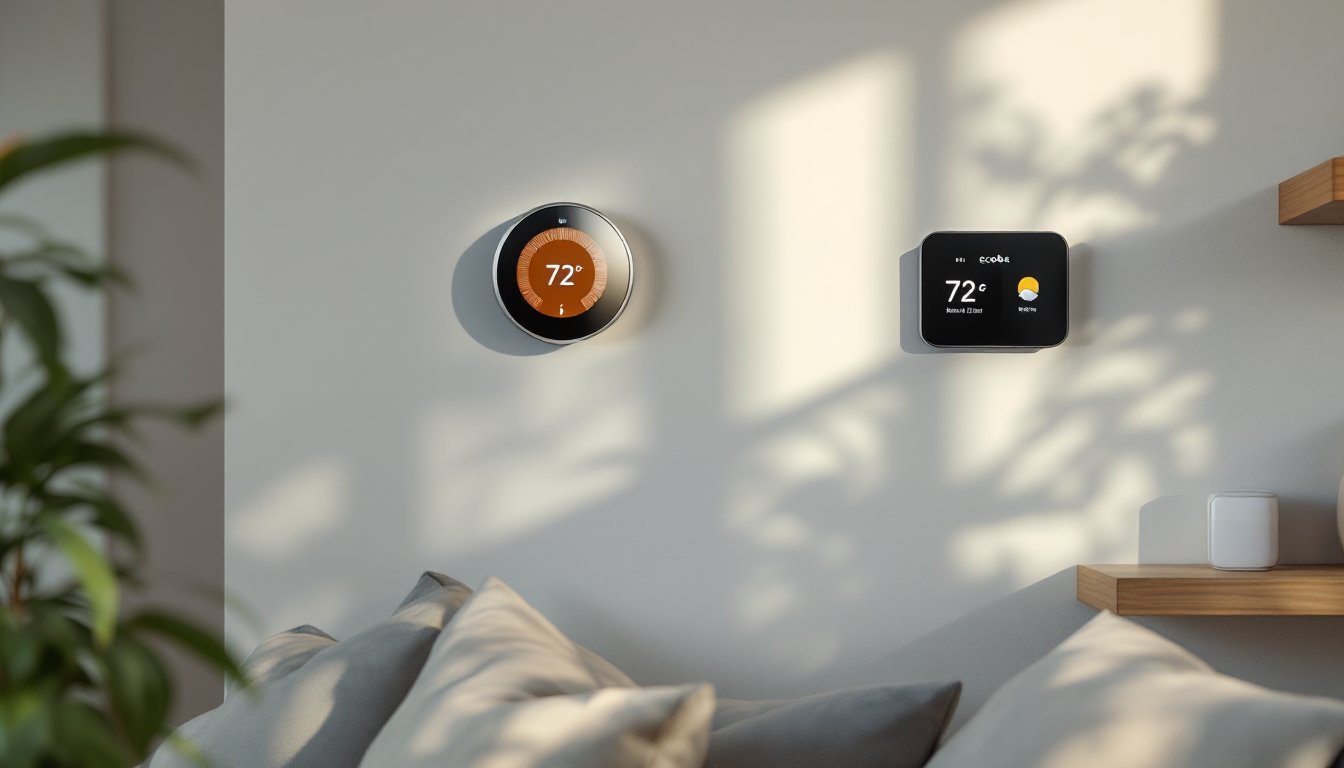
Nest Learning Thermostat (4th gen) features a borderless glass front with a 2.7-inch circular LCD that transitions to a clock or weather display when idle. The metal dial (now capacitive touch rather than mechanical) and polished finish give it a jewelry-box aesthetic. It sits flush against the wall and comes in polished steel, copper, or black finishes.
Ecobee SmartThermostat Premium (and the mid-tier Enhanced model) uses a 3.5-inch rectangular touchscreen with a black plastic housing. It’s functional rather than sculptural, think tablet mounted to drywall. The larger screen shows more data at a glance: current temp, humidity, weather forecast, and Alexa notifications if enabled. Ecobee’s display stays on 24/7 unless manually dimmed: Nest’s wakes on approach thanks to its motion sensor.
Installation footprint matters if you’re replacing an older unit. Nest’s 3.3-inch diameter covers most old thermostat outlines and screw holes. Ecobee’s 4.2 x 4.2-inch square may leave gaps if your previous thermostat was round or smaller, be ready to patch and paint, or use the included trim plate.
Both mount to a standard backplate with wire terminals. If aesthetics rank high, Nest edges ahead. If you want maximum screen real estate for daily interaction, Ecobee wins.
Smart Home Integration and Compatibility
Nest integrates tightly with Google Home and the Google ecosystem. Routines (“Good Morning,” “Leaving Home”) can adjust the thermostat alongside lights, locks, and cameras. Nest works with Samsung SmartThings, Amazon Alexa, and IFTTT, but Google Assistant offers the deepest control. Apple HomeKit support was dropped after Google acquired Nest in 2014, which rules it out for HomeKit-only households.
Ecobee supports Apple HomeKit, Alexa, Google Assistant, Samsung SmartThings, and IFTTT out of the box. The Premium model has a built-in Alexa speaker, turning the thermostat into an Echo Dot that plays music, answers questions, and controls other Alexa devices. This eliminates the need for a separate smart speaker in hallways or living rooms, handy if you’re consolidating devices.
For home automation platforms like Home Assistant or Hubitat, both thermostats integrate via API or community plugins. Ecobee’s local API is more accessible for advanced users running self-hosted systems.
Many smart home comparisons highlight Ecobee’s broader compatibility, especially for multi-platform households. If you run a mix of Apple, Google, and Alexa gear, Ecobee keeps all doors open. If you’re all-in on Google, Nest offers tighter integration.
Energy Savings and Learning Capabilities
Both companies claim 10–23% savings on heating and cooling costs, but actual results depend on your existing thermostat, HVAC efficiency, insulation, and climate zone. Independent testing by ENERGY STAR and utility rebate programs supports these ranges, though savings skew higher when replacing non-programmable thermostats in extreme climates.
Nest’s learning algorithm observes your manual adjustments for about a week, then auto-generates a schedule. If you override it frequently, Nest adapts. The Farsight feature (4th gen) displays the temperature in large digits when you walk past, reinforcing awareness of settings. Nest also uses weather data and sunlight exposure (if you enable Sunblock) to pre-cool or delay heating.
Ecobee’s Eco+ suite includes Smart Home/Away, Schedule Assistant, and Feel Like Mode (adjusting for humidity). The SmartSensors average temperatures across rooms, which prevents the HVAC from running longer than needed to heat or cool an empty zone. In practice, this matters more in larger homes (2,000+ sq ft) with zoning issues.
Recent thermostat testing shows Ecobee’s sensor-based approach often edges out Nest in multi-level homes, while Nest performs slightly better in smaller, open-plan spaces where a single sensor suffices. Both track runtime and provide monthly reports through their apps, itemizing heating, cooling, and fan usage by day.
Neither thermostat physically controls humidity or air quality, but Ecobee Premium includes air quality monitoring (VOC and humidity sensors), displaying indoor air quality scores and suggesting ventilation or filter changes.
Installation Process: DIY-Friendly or Professional Required?
Both thermostats are DIY-friendly if you have basic electrical comfort and existing 24V HVAC wiring. Expect 30–60 minutes for a straightforward swap. Turn off power at the breaker (not just the furnace switch), label each wire with the included stickers, disconnect the old thermostat, mount the new backplate, reconnect wires, and power up. The thermostat walks you through setup on-screen.
C-wire (common wire) complications arise in older homes. If your old thermostat used only four wires (R, G, Y, W), you may lack a C-wire for continuous power. Nest includes a Nest Power Connector that taps power from your furnace control board: Ecobee ships a Power Extender Kit (PEK) that does the same. Both require opening your furnace and wiring the adapter to the control board, doable for a handy homeowner but intimidating for beginners. If you’re uncomfortable working inside the furnace, hire an HVAC tech ($100–$200 service call in most markets).
Multi-stage systems (two-stage heat, two-stage cool) and heat pumps with auxiliary heat are supported, but setup menus get more complex. Nest’s guided configuration asks yes/no questions about your system: Ecobee’s app includes a wiring wizard with photos. Both support dual-fuel systems (heat pump + gas furnace), but configuring switchover points requires understanding balance points and lockout temperatures, consult your HVAC manual or a pro if unsure.
Permits aren’t required for thermostat replacement (it’s low-voltage wiring, not line voltage), but some jurisdictions classify HVAC control changes as mechanical system alterations if you’re adding new wiring or modifying the furnace. Check local codes if you’re running a new C-wire from the panel.
Both apps include installation videos and live chat support. Ecobee offers phone support during business hours: Nest relies on community forums and Google Support (response times vary).
Price and Value: Which Thermostat Offers the Best ROI?
Ecobee SmartThermostat Premium retails for $249 and includes one SmartSensor (additional sensors run $79 for a two-pack). The Ecobee SmartThermostat Enhanced (no air quality monitor, no premium finish) sells for $189. Both support the same core features, remote sensors, Eco+, and voice control.
Nest Learning Thermostat (4th gen) lists at $279. The Nest Thermostat (budget model, released 2020) costs $129 but lacks the learning algorithm, Farsight, and premium build, it’s programmable with app control, closer to a connected programmable stat than a true “smart” thermostat. Nest Temperature Sensors add $40 each or $99 for a three-pack.
Utility rebates can shift the math. Many power companies offer $50–$100 rebates for ENERGY STAR-certified smart thermostats through programs like Nest Rush Hour Rewards or ecobee’s demand response. Check your provider’s site, some subsidize the hardware directly, dropping Nest to under $200 or Ecobee to $150.
Over a five-year lifespan, assuming 15% annual HVAC cost savings on a $1,500/year heating/cooling bill, either thermostat pays for itself in under two years. The best smart thermostat reviews for 2026 consistently rank both Ecobee and Nest among top performers for ROI, with the edge going to whichever model you snag on sale or with a bigger rebate.
Long-term value factors include software support (Google and Ecobee both push firmware updates for 5+ years) and sensor ecosystem expansion. Ecobee’s sensors are cheaper per unit, which matters if you’re covering four or five rooms. Nest’s 10-year temperature sensor battery life (vs. Ecobee’s 3-year coin cells) reduces maintenance.
If you’ll use the included sensor, Ecobee Premium offers better out-of-the-box value. If you’re fine without sensors and want the cleanest interface, Nest Learning justifies the premium, especially during sales or with rebates.
Conclusion
Choosing between Ecobee and Nest comes down to smart home loyalty, home layout, and interface preference. Ecobee fits multi-room homes, Apple HomeKit users, and anyone who wants an Alexa speaker built in. Nest suits Google-centric setups, smaller spaces, and homeowners prioritizing design. Both deliver energy savings and remote control, either is a solid upgrade from a programmable thermostat. Check your wiring, claim any available rebates, and pick the one that matches your ecosystem.